

This is Part 2 of a two-part series. Part 1 covered how AI has fundamentally changed public relations, the science underneath, the new trust economy, and how the daily work of PR is different now. This part covers the new crisis playbook for AI-mediated threats, what PR 3.0 means for every role in the profession, and the ethical foundation that holds all of it together.
AI has placed a new layer of intelligence between communicators and the humans they reach. That layer is synthesizing everything organizations have ever published — every press release, every quote, every webpage, every piece of content — into the narratives that millions of people now receive as conversational truth. The signals that strategic communicators create are training the systems that shape what the world believes.
That is the paradigm shift described in Part 1 of this series, which covers the three eras of public relations, the science of how communication actually affects human beings, the new trust economy, and how every core PR function operates differently now.
This piece is about what comes next: the crises that are already here and that most organizations are unprepared for, what this era demands of every specific role in the profession, and the ethical line that will determine whether PR 3.0 is a force for civic stabilization or another engine of manipulation.
Let’s start with the crises, because they aren’t waiting for us to be ready.
Crisis Communication in PR 3.0: A New Playbook
Crisis communication has always been the highest-stakes discipline in the communications profession. It’s where reputations are saved or lost, where institutional trust is either reinforced or shattered, and where the consequences of getting it wrong are measured not in metrics but in real damage to real people and real organizations.
Every previous era of crisis communication has been built around a common assumption: that a crisis originates with a human actor. A journalist breaks a story. An employee leaks information. An executive says something damaging. A product fails publicly. In PR 2.0, social media added velocity — crises could spread in minutes instead of hours, and always-on monitoring became a baseline requirement.
PR 3.0 breaks this assumption entirely. It introduces a category of crisis that has no single human origin point, no traditional news cycle, and no correction mechanism that most organizations have ever planned for: the AI-mediated crisis.
These crises are born in the intelligence layer itself — in the gaps, imbalances, and distortions of the signal ecosystem that AI systems draw from when they answer questions about your organization. They can emerge without a bad actor, without a triggering event, and without anyone in the organization knowing they’re happening until the damage has compounded.
Understanding these threats, and building the playbook to address them before they arrive, is no longer optional. It is a core function of crisis communication in the Intelligence Era.
The New Threat Categories
Deepfake Crisis
Imagine a synthetic video of your CEO surfaces saying something they never said, in a voice indistinguishable from their own, with facial expressions that match perfectly. It hits social media on a Friday afternoon and starts spreading before anyone on your team knows it exists.
This is not science fiction. Deepfake technology is accessible, improving rapidly, and already being used in targeted attacks on public figures and organizations. The traditional crisis response — issue a denial, contact journalists — is rarely sufficient on its own, because a denial is an assertion. In a world where anyone can manufacture a convincing video, an assertion doesn’t carry enough weight.
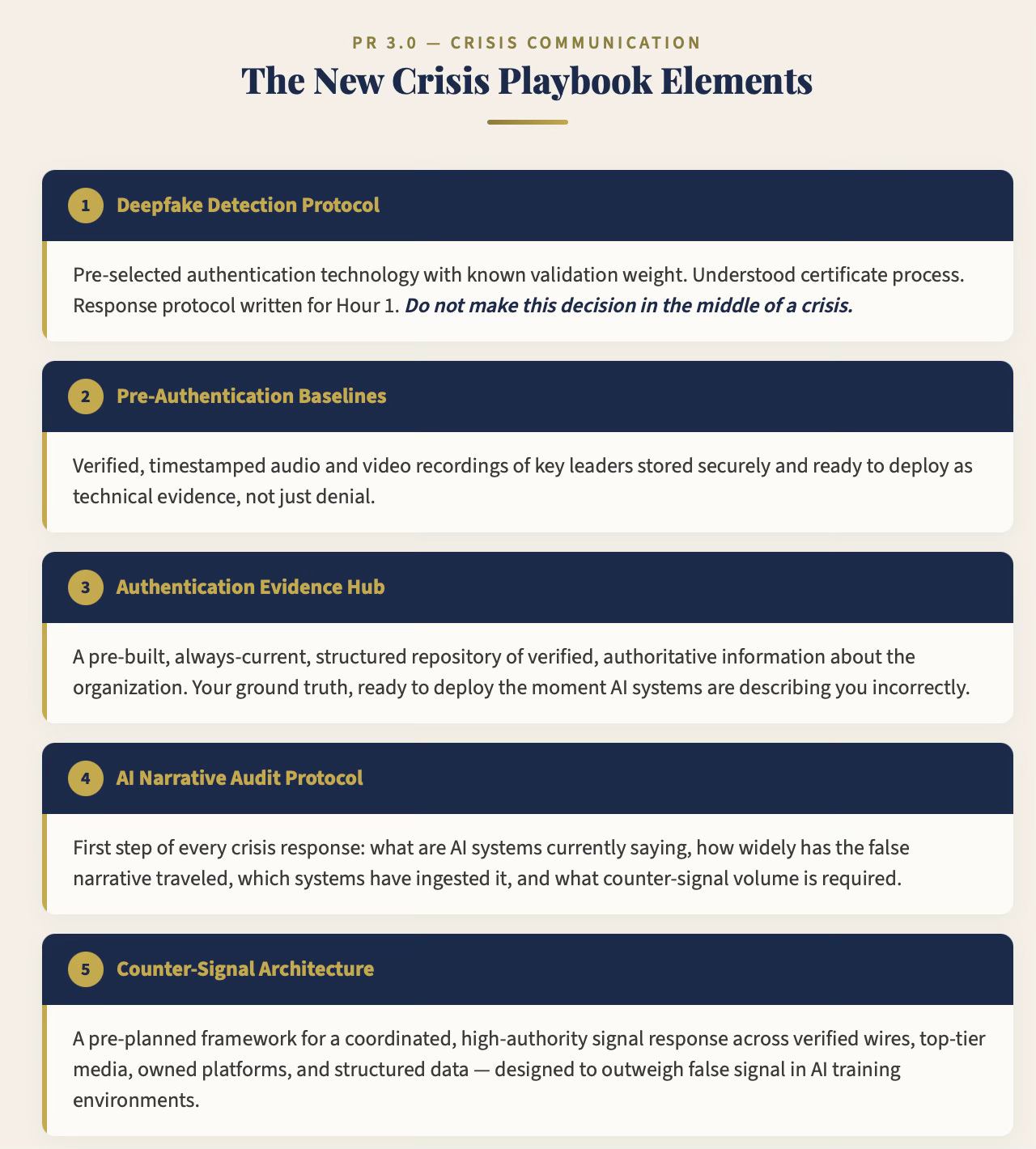
Effective PR 3.0 crisis plans specify in advance: which deepfake detection technology you will deploy, what the certificate of authentication it returns looks like and how you use it publicly, and what your counter-narrative response protocol is within the first hour. Tool selection matters as not all authentication technologies carry the same third-party validation weight, and in a crisis, the credibility of the tool you cite is part of your credibility. This is a decision worth making before you need it.
PR 3.0 crisis planning also benefits from pre-authenticated baselines: verified, timestamped audio and video recordings of key leaders that can be used to technically disprove deepfakes rather than simply deny them. A denial is an assertion. A verified baseline is evidence.
AI Hallucination Crisis
This one is quieter but potentially more damaging over time. AI systems confidently stating false information about your organization as fact — not because of a bad actor, not because of a news story, but because of gaps, inconsistencies, or imbalances in the signal ecosystem.
There is no author to contact. There is no editor to call. There is no retraction to request. The AI isn’t lying, rather it is synthesizing what’s available, and what’s available is incomplete or skewed. The correction requires counter-signal: authoritative, structured, high-volume content that gives AI systems accurate information to synthesize instead. And it requires ongoing monitoring, because AI systems are continuously re-ingesting and updating, which means the correction isn’t a one-time fix. It’s a sustained effort.
Coordinated Misinformation at Scale
This is the most sophisticated and most dangerous category. Not a single bad article or one disgruntled social media post, but coordinated false signal seeding across multiple platforms simultaneously, designed specifically to be ingested by AI systems and reproduced as apparent fact.
This is not a media crisis. It is a signal warfare crisis. The adversary understands how AI training ecosystems work and is deliberately flooding them with false signal to reshape the AI-generated narrative about your organization, your industry, or your issue.
The response requires a counter-signal architecture — a coordinated, high-authority signal flood across verified wires, top-tier media, owned platforms, and structured data designed to outweigh the false signal in the AI training environment. This must be pre-planned. By the time you’re building it during a live crisis, you’ve already lost ground that will take weeks or months to recover.
AI Narrative Drift Crisis
This is perhaps the most common of the four and the most insidious, because it happens silently. No crisis trigger, no bad actor, just the gradual accumulation of inaccurate, outdated, or imbalanced information across the AI training ecosystem that slowly changes what AI systems say about your organization.
A product you discontinued three years ago still appearing as your flagship offering. A criticism from a single article being weighted disproportionately because no counter-signal was ever created. A competitor’s narrative being synthesized alongside yours in ways that redefine your positioning without your knowledge.
Organizations often discover this kind of drift only when a prospect, journalist, or stakeholder mentions what “the AI said about you” — by which point it has been compounding for months or years. The cost of correction grows with every day the drift goes unaddressed. Ongoing AI narrative monitoring, built into regular practice rather than reserved for crisis response, is what catches drift before it compounds.
The New Crisis Playbook Elements
Every PR 3.0 crisis communication plan needs these elements as baseline infrastructure. If your crisis plan was written before AI became a primary information channel, it is already out of date.
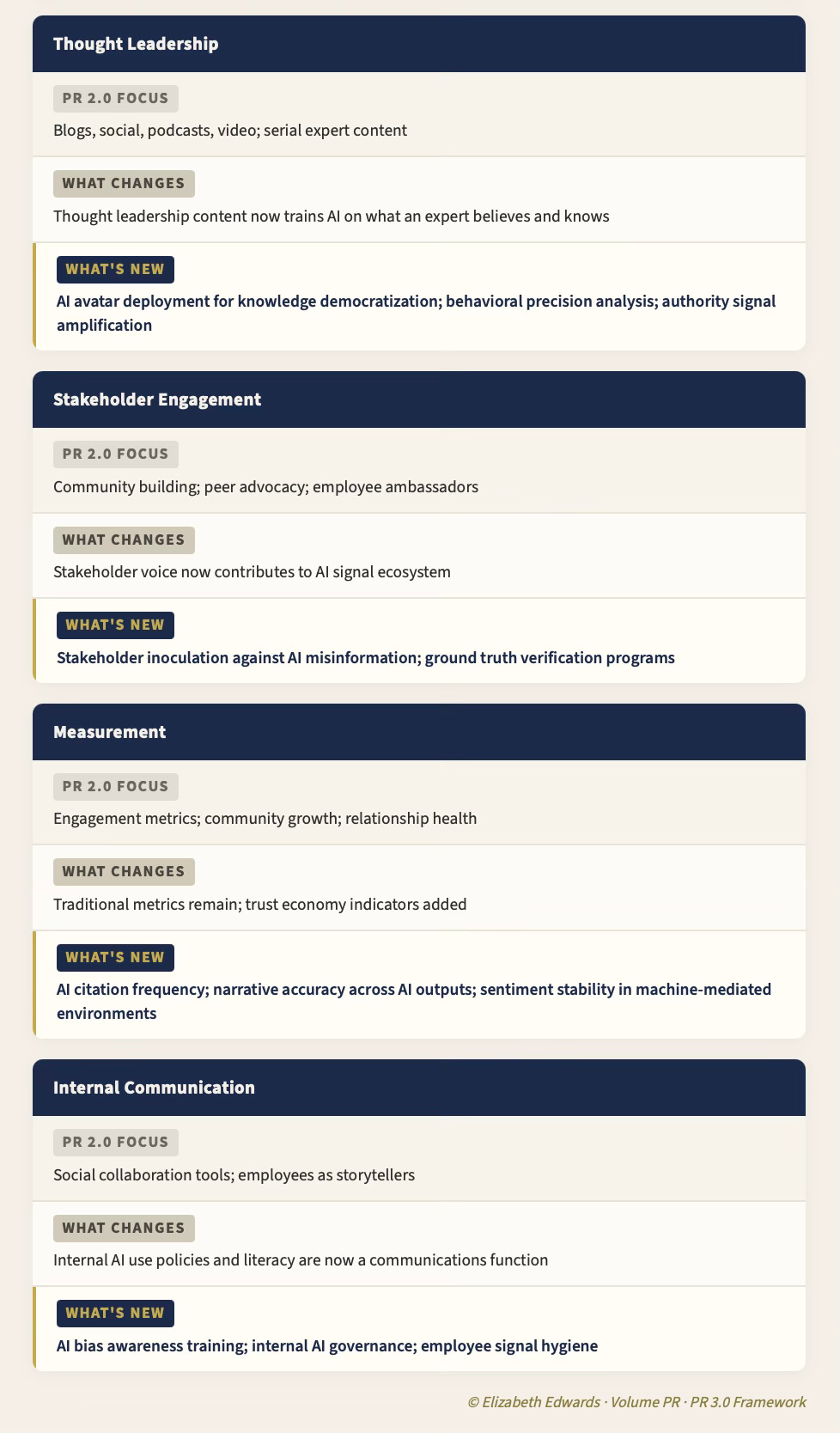
PR 3.0 Across Practice Areas: What Changes, What Stays, What’s New
One of the most important things to understand about PR 3.0 is that it does not replace the core disciplines of strategic communication. Media relations still matters. Content still matters. Reputation management still matters. Stakeholder engagement, measurement, internal communications, all of it still matters. The fundamentals are not obsolete.
What has changed is the environment in which those fundamentals operate. Every practice area now has an additional dimension — the intelligence layer — that affects how the work is created, distributed, received, and measured. Some functions are expanded. Some are transformed. And some are entirely new, with no precedent in previous eras.
For those of us who have felt for years that our profession deserves more strategic authority and a bigger seat at the leadership table, this is the moment that earns it. Because in PR 3.0, the strategic communicator is no longer a support function. They are the architect of how an organization exists in the intelligence layer that is now mediating most of the world’s information.
The following table maps the major practice areas through the PR 3.0 lens — showing what remains from PR 2.0, what changes, and what is entirely new.
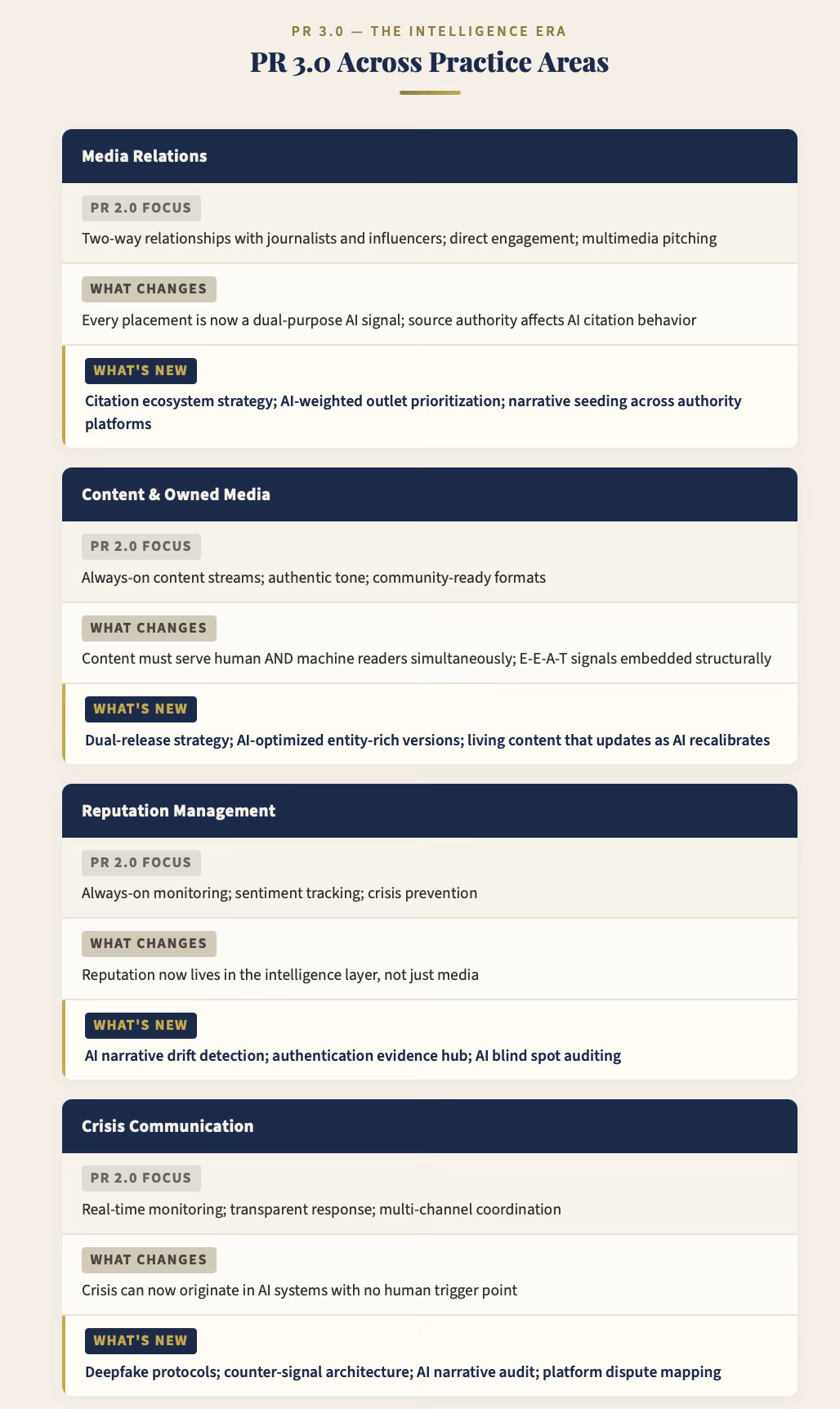
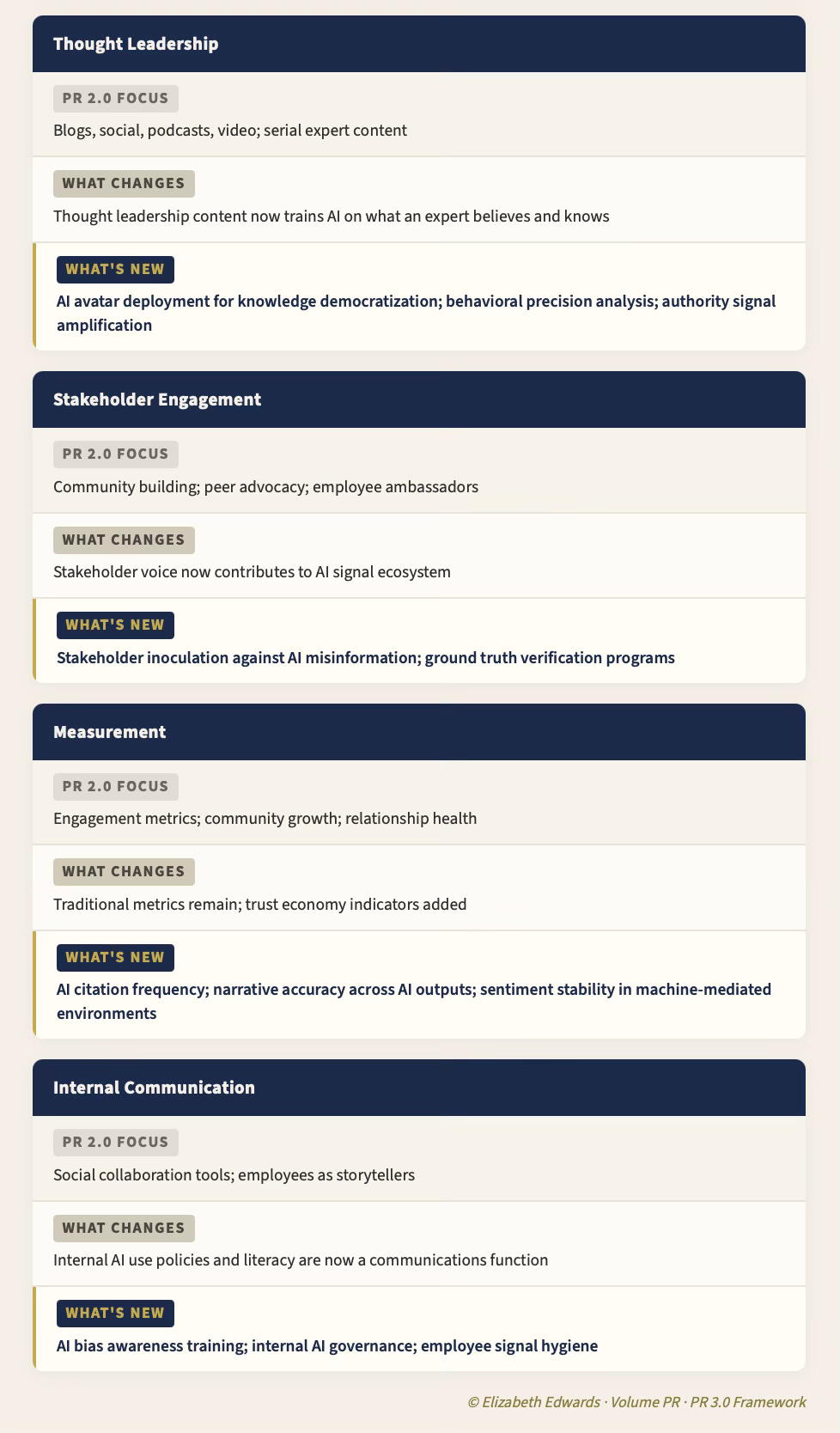
PR 3.0 by Role: What This Era Requires of Different Practitioners
The Intelligence Era does not affect every communication role in the same way. A government PIO managing public safety information faces a fundamentally different AI challenge than a startup PR professional trying to establish competitive positioning. A healthcare communicator whose inaccurate AI narrative could affect patient safety is operating under different stakes than an internal communicator rolling out AI governance policies.
But every role is affected. And in every case, the shift follows the same structural pattern: the signals you create now live in two worlds simultaneously, the human world and the intelligence layer. How well you manage both determines how effectively you can serve the people and organizations that depend on you.
The following breakdowns map what PR 3.0 means for each role, what changes, what stays, and what is entirely new.
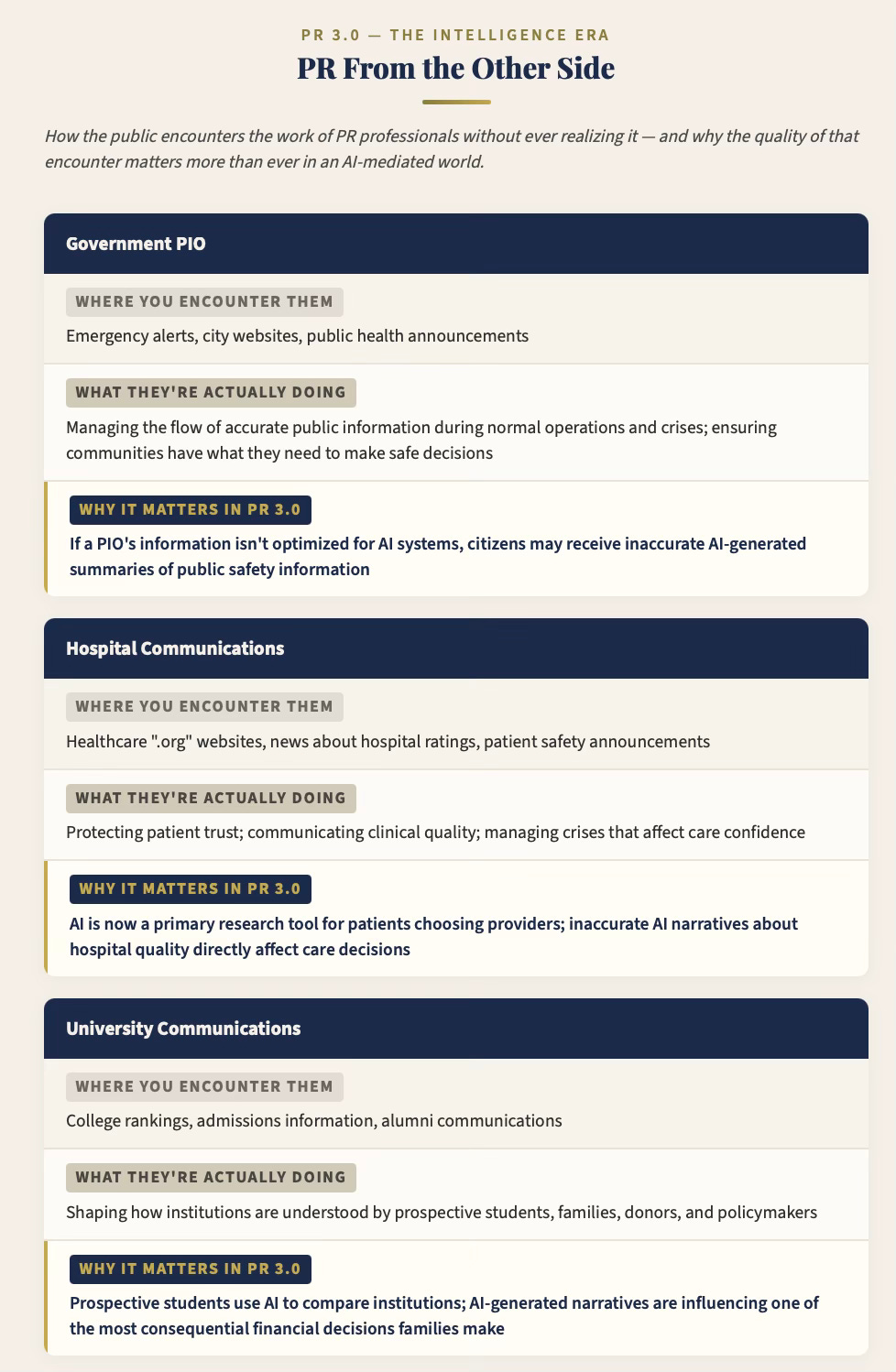
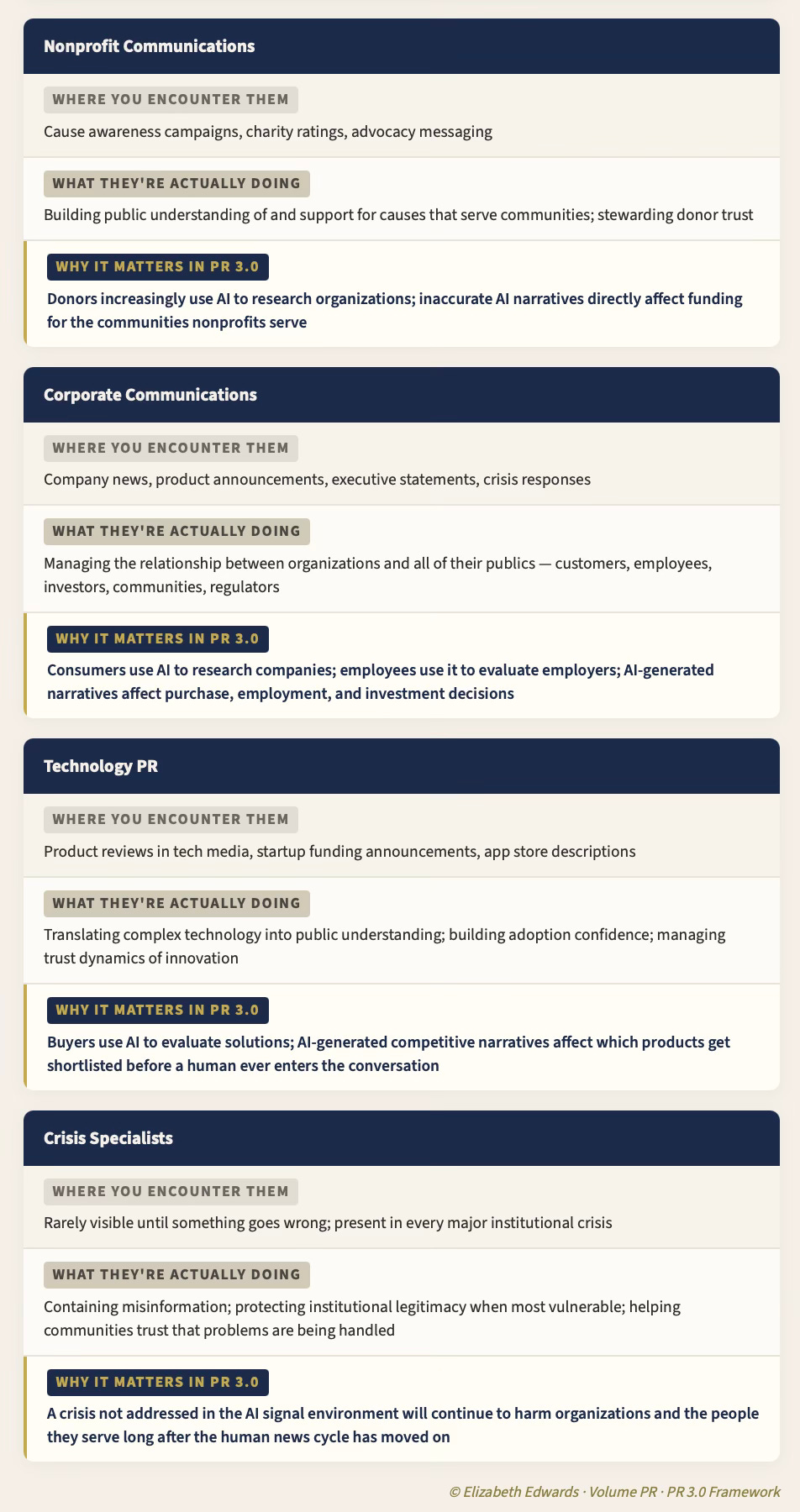
PR From the Other Side: How the Public Encounters This Profession Without Knowing It
I want to pause here and flip the lens entirely, because everything above has been written from the perspective of the practitioner. But PR 3.0 isn’t just about what we do. It’s about who it reaches and most of those people have no idea we exist.
That’s not an accident. It’s how the profession works. The best PR is invisible. When a parent is researching hospitals at 2 a.m. trying to figure out where to take their child, they don’t think about who created the information they’re reading. When a prospective student is comparing universities, they don’t know that a communications team shaped the narrative that’s influencing one of the biggest financial decisions their family will ever make. When a citizen is trying to understand a public health directive during a crisis, they don’t realize that a PIO wrote the language they’re relying on to keep their family safe.
These are not small interactions. These are some of the most consequential decisions in people’s lives and they are increasingly being mediated by AI systems that synthesize the signals our profession creates.
If we get this right, people make better decisions with better information. If we get it wrong, or if we simply don’t show up in the intelligence layer, people make life-altering choices based on whatever fragments AI could find. That’s not hypothetical. That’s happening right now, to real people, in every sector represented in this table.
The Ethical Foundation: Power Requires Discipline — and Science
I need to be direct here, because this is the part that will determine whether PR 3.0 is something the world benefits from or something the world suffers from. And I don’t think our profession has been honest enough about what’s at stake.
We all know the spectrum. Every one of us has seen it. There are communicators who take their responsibility seriously, who lose sleep over whether the language is right, who push back when leadership wants to spin, who understand that the relationship between an organization and its publics is sacred and fragile. And there are people in our industry who will say whatever gets the click, manufacture whatever perception pays, and optimize for short-term attention without a second thought about what it costs the people on the receiving end.
That spectrum has always existed. What’s different now is the scale. When your communication is training AI systems that will reproduce it at machine scale to millions of people, the ethical quality of what you create is no longer just a professional standard, it is a civic consequence.
And here’s where the science makes the case that ethics alone cannot.
The Affective Intelligence framework doesn’t just say ethical communication is preferable. It shows that ethical communication is structurally superior and it shows why.
Communication that expands capacity — that helps audiences comprehend, consider, connect, remember, and choose from a place of coherence — produces durable trust, sustainable engagement, and sound decision-making. It builds the conditions under which relationships actually hold. This is not aspirational. It is what happens, measurably, when communication is designed to work with human instinctive architecture rather than against it.
Communication that compresses capacity —that exploits fear, urgency, scarcity, and identity threat to produce fast reactions — degrades the audience’s ability to reason, trust, and engage over time. It produces short-term compliance and long-term erosion. And at machine scale, it doesn’t just damage a brand or mislead a consumer, it contributes to the degradation of the collective trust infrastructure that organizations, institutions, and democratic societies depend on to function.
This is why ethical communication isn’t a nice-to-have in PR 3.0, it is structurally superior. It is the only approach that produces durable results, because it is the only approach that preserves the conditions under which durable results are possible. The science of affect makes this a causal claim, not a moral preference.
Every major communications shift has attracted its share of bad actors. The rise of the internet brought black-hat SEO and reputation manipulation. GEO and AEO are following the same pattern, with practitioners who built careers on manufactured signals now pivoting to sell manufactured AI influence. Those willing to cut ethical corners tend to move quickly. Which is exactly why those committed to legitimate practice benefit from moving with intention, clarity, and the authority of the profession behind them.
Without ethical discipline, signal architecture becomes disinformation logistics. With it, that same architecture becomes civic stabilization — the infrastructure of durable trust in a volatile world. The difference between communication that amplifies anxiety, confusion, and distrust, and communication that helps people, organizations, and societies navigate complexity with enough clarity to make good decisions.
This is why the ethical foundation is not a value-add in PR 3.0 but the load-bearing structure of the entire enterprise.
What This Moment Requires
Everything in this two-part series points to a single conclusion: the communications profession has crossed a threshold, and there is no going back.
The Intelligence Era asks us to become a deeper, more conscious, more scientifically grounded version of the one we already practice. It asks us to understand that the signals we create now live in an intelligence layer that shapes what millions of people understand to be true, about our clients, about our organizations, about our industries, and about the world.
It asks us to think as signal architects — professionals who design not just messages but entire signal ecosystems that AI will synthesize and reproduce at scale. It asks us to develop genuine power literacy — the ability to understand what our tools are optimizing for and to make deliberate choices about which buttons we push and which ones we refuse to touch. It asks us to operate continuously rather than episodically — because the intelligence layer never pauses, and the signal environment compounds whether we’re paying attention or not.
And it asks us to carry our ethical grounding not as a constraint but as the competitive and civic advantage it actually is — the thing that makes the difference between wielding this level of influence responsibly and contributing to the very instability we are being called to help resolve.
When communication professionals fully understand what they are actually doing — that they are shaping signal within intelligence systems, designing the affective conditions under which humans make consequential choices, participating in the architecture of the trust economy — everyone benefits. The organizations they serve. The leaders they counsel. The publics on the receiving end of AI-mediated information. The societies those decisions ripple through.
Conclusion
Strategic communication professionals — the people who decide what narrative exists, in what form, with what authority, with what emotional architecture — are now participating in something larger than any single campaign, client, or crisis.
They are shaping the signal environment that AI synthesizes into what millions of people understand to be true.
That is an extraordinary amount of influence. It is also an extraordinary amount of responsibility — ethical, civic, and social. The communicator who understands what they are actually doing is not just a better strategist. They are a more accountable one. The choices made at the level of signal architecture — what gets amplified, what gets silenced, what gets framed as credible and what doesn’t — ripple outward in ways that affect how communities make decisions, how institutions earn or lose trust, how societies navigate complexity.
Strategic communicators who understand PR 3.0 don’t just have a professional advantage, they have a clearer picture of what their work is for, and what it owes to the world it reaches.
The professionals who embrace that clarity, who wield this power wisely, ethically, and with genuine awareness of what is at stake, are not just building better careers, they are contributing to a more stable, more trustworthy, more coherent world.
And that has always been the point.
Elizabeth Edwards is the founder of Volume PR, Engagement Science Lab, and The Affect Institute. She is the President of the PR Consultants Group and a lead Behavioral Science Communicator and ethical AI speaker for the Public Relations Society of America (PRSA). She is the originator of the Affective Intelligence and PR 3.0 frameworks — built on twenty-five years of interdisciplinary research at the intersection of behavioral science, communication, and ethics. She is the originator of the Affective Intelligence and PR 3.0 frameworks — built on twenty-five years of interdisciplinary research at the intersection of behavioral science, communication, and ethics. She speaks nationally on Affective Intelligence, the science of human decision-making, why bias training has failed and what actually works, AI and ethical influence, and how organizations build trust in an intelligence-mediated world. To book Elizabeth as a keynote speaker or trainer, contact her team here.
Subscribe to Affective Influence to receive new essays as they’re published.